
The Most Important Urban Firestorm Defense You Never Hear Of
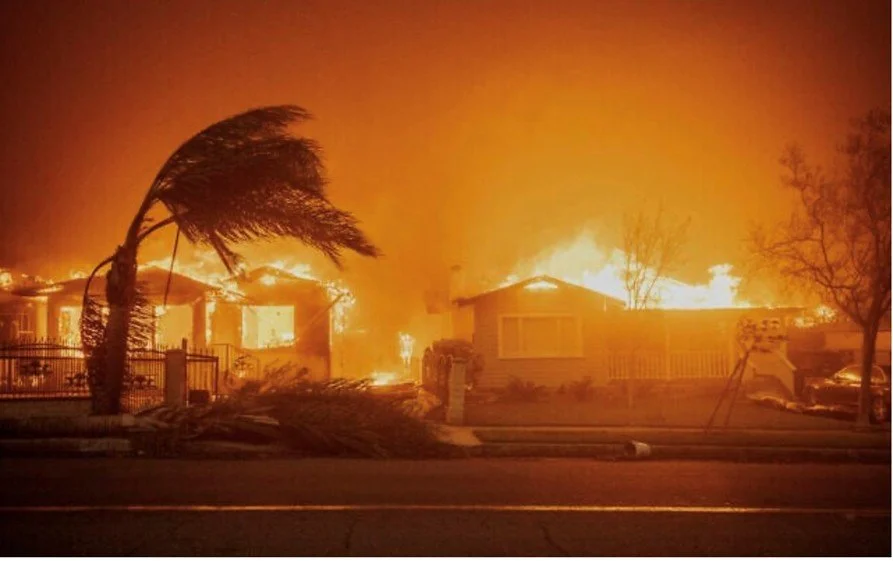
.It isn’t vegetation clearance, a new building material, or a five-foot rule. It’s distance. In California’s Very High Fire Hazard Severity Zones, fire safety has long depended on roughly 30 feet of defensible space, because spacing reduces radiant heat, limits ember accumulation, and slows structure-to-structure ignition. As development intensified and buildings moved closer together, that basic fire-defense principle faded from view—replaced by a growing fixation on what happens right at the wall. What rarely gets discussed is simple: firestorms spread through proximity, and no amount of clearance at the edge of a structure can substitute for space between structures.
One of the most overlooked facts in California’s wildfire framework is also one of the most consequential: in Very High Fire Hazard Severity Zones, the intended defensible space around structures has long been 30 feet, not five.
That distinction matters—because fire in cities is not primarily a vegetation problem. It is a spacing problem.
The Original Logic of the 30-Foot Setback
California’s fire regulations were never built around the idea that safety could be achieved by scraping vegetation immediately next to homes. The 30-foot defensible space standard emerged from a much more basic fire principle: distance reduces heat, flame contact, and ember accumulation.
That space was meant to:
reduce radiant heat exposure between structures,
limit direct flame contact,
interrupt ember buildup zones,
and give firefighters room to operate safely.
In other words, it was about fire physics, not landscaping preferences.
How We Ended Up Debating Five Feet Instead
Over time, land-use pressures—particularly the push for higher density in fire-prone areas—began to erode the role of setbacks. As lots became smaller and buildings moved closer together, the 30-foot buffer quietly became inconvenient.
Rather than confronting the fire implications of reduced spacing, policy attention shifted inward—to the first five feet around a structure—and began treating clearance at the wall as a substitute for distance between buildings.
It isn’t.
No amount of vegetation removal in the first five feet can compensate for structure-to-structure proximity in a wind-driven firestorm.
Why Spacing Drives Structure Loss in Urban Firestorms
Once fire enters an urban area, the dominant drivers of loss are:
wind speed and direction,
ember density,
radiant heat transfer,
and how close structures are to one another.
In tightly packed neighborhoods, homes ignite homes. Embers accumulate in corners, decks, eaves, and vents. Radiant heat overwhelms materials long before flames arrive. These processes are magnified when setbacks are reduced.
This is why post-fire analyses repeatedly show that density and spacing correlate more strongly with structure loss than surrounding vegetation.
The uncomfortable truth is that clearance rules are often being asked to solve a problem created by land-use decisions.
Setbacks Are Not Empty Space — They Are Design Space
Reframing setbacks as “fire defense” changes the conversation entirely.
A setback does not need to be:
scraped bare,
lifeless,
or ecologically destructive.
When treated as a design envelope, a setback can:
host low-flammability, moisture-retaining native canopy,
reduce wind speeds at the surface,
interrupt ember pathways,
and create thermal and spatial buffering between structures.
This is especially important in the wildland–urban interface, where individual parcels function as part of a shared fire system, not isolated islands of risk.
The Policy Tension We’re Avoiding
The current focus on five-foot clearance zones sidesteps a harder question:
If fire-safe spacing matters—and the science says it does—what does it mean to keep approving reduced setbacks and increased density in the most fire-exposed areas of the state?
That is not a landscaping question.
It is a land-use question.
And until it is addressed honestly, clearance mandates will continue to carry the burden of risks they were never designed to solve.
Why This Matters Going Forward
Re-centering fire safety around spacing, setbacks, and structure separation does not mean abandoning home hardening or vegetation management. It means putting them back in their proper role—supporting measures, not substitutes for distance.
In fire-prone cities, setbacks are not a relic of outdated zoning.
They are one of the most powerful fire defenses we have—and one we’ve been quietly designing away.