
How Urban Fires Work And Why It Matters
Urban Fires 101
Urban fires can trigger urban conflagrations (UCs), large uncontrollable fires that spread rapidly through a densely populated area, causing widespread destruction. These events are low-frequency and high-severity. Below are the principal components that can enable UC:
1. Extreme fire weather conditions
At the core of any UC event lies the presence of sustained severe fire weather and severe antecedent conditions. These conditions are characterized by high temperatures, low relative humidity, and critically, strong winds, which are also causes for a sudden drop in fuel moisture.
Under these conditions, dry fuels such as dead vegetation, buildings, and urban debris become highly combustible, reducing the energy needed to ignite them and allowing fires to spread with explosive speed.
Wind speeds exceeding 30 miles per hour with higher gusts can dramatically alter fire behavior. Wind accelerates flame fronts, lofts embers, and interacts with urban layouts to increase hazard, especially in hillside areas with narrow streets or continuous rows of buildings.
Although these conditions are necessary, they are not sufficient as causes of urban conflagration. There is a random component that depends on the speed at which the fire moves, and on the likelihood that the embers produced by this fire will propagate in the right locations, possibly creating onsets of urban conflagration because of a lack of fire fighting, and leaving emergency response incapable of suppressing the fire in urban areas.
2. Windborne ember transport (Spotting)
Windborne ember transport, also known as 'spotting,' is a mechanism for long-distance ignition. Embers often ignite buildings from miles away, bypassing firebreaks or defensible space. Embers can accumulate in roofs, vents, eaves, decks, fencing, gutters, or other vulnerable openings, igniting structures from the outside in — or the inside out.
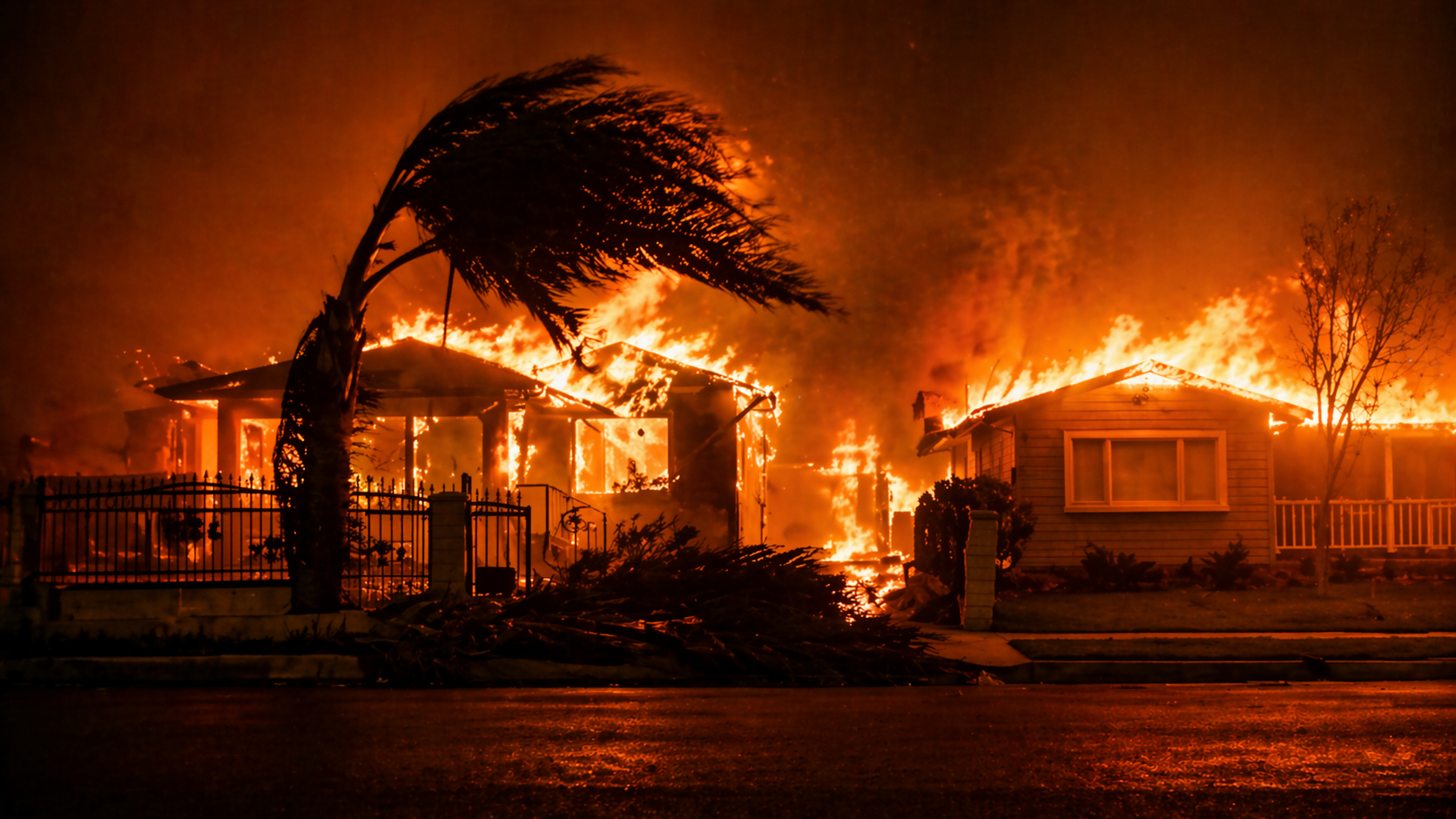
While it's common to think of urban and suburban landscapes filled with ember-producing trees as the primary threat, recent fires show that buildings in dense communities are the primary driver of devastating urban conflagrations (e.g., the 2025 Palisades and Eaton Fires) — not a forest fire front or landscaped yards.
In urban fires, buildings are dry fuel and it is the buildings that function like trees in a forest — once one ignites, it can rapidly spread fire building-to-building through neighborhoods, turning houses themselves into the fire’s fuel.
In dense neighborhoods, closely spaced buildings can allow fire to move through communities the way flames move through trees in a forest
Unlike buildings, living plants in residential yards are not dry fuel. Healthy irrigated residential landscapes contain significant internal moisture — what fire scientists call Live Fuel Moisture Content — while buildings are largely built and composed of dry combustible materials.
Reports have documented embers travelling up several miles under strong winds. For instance, during the 2017 Tubbs Fire, embers crossed a six-lane highway, igniting the Coffey Park neighborhood of Santa Rosa, CA, a residential subdivision with no direct forest proximity.
3. Urban fuel continuity and structure vulnerability
A critical enabler of UC is building continuity within urban areas. This includes close structure spacing (e.g., less than 30 feet), combustible cladding or roofing materials (e.g., timber, untreated fences, vinyl windows), dead vegetation, dry mulch and accumulated debris in gutters, under and on decks, or against walls, etc.
Once a structure ignites, nearby buildings may be exposed to radiant heat sufficient to cause secondary ignition and/or a sudden shower of embers of burning debris. Under windy conditions, this can occur in minutes, creating a cascade effect.
Moreover, even a single point of failure—such as an unsealed eave may cause ignition hours after a fire has spread through a neighborhood. Structure-to-structure ignition has been observed in areas with minimal vegetation, as illustrated in images of the 2025 Palisades and Eaton fire events, highlighting that the structures are the fire’s fuel in built environment.
4. Structural density and urban topology
Observations have shown that UCs are more likely to occur under extreme weather conditions in environments with medium to high-density development. Some of the factors that increase the potential for urban fire spread are:
Row housing or duplexes with shared walls, terraced houses
Narrow setbacks of less than 30-feet or side-access only lots
Topographic funneling (when terrain features such as canyons, valleys, and slopes channel wind and embers through neighborhoods)
Cul-de-sacs or one-way ingress/egress that hinder firefighting access and slow evacuations
These conditions make evacuation and firefighting more difficult, allowing fire to spread more quickly from structure to structure. In dense neighborhoods, the concentration of buildings can actually help drive the fire’s spread.
5. Fire Suppression overload and infrastructure failure
Even highly capable fire services can become quickly overwhelmed under UC conditions as their mission switches from saving properties to saving lives. Fires can spread so rapidly that the initial response fails, with local brigades being pushed toward evacuation and perimeter control rather than suppression.
In situations where three or more houses burn in the same street, hydrants become overwhelmed and are unable to function effectively to extinguish fires.
Under high wind speeds, small fires spread within minutes across entire parcels. Alongside this, the communication and utilities powerlines break down, which complicates emergency response.
Afternoon and nighttime ignitions complicate response further—visibility, coordination, and aerial operations become more difficult. While emergency services might adapt to these constraints (e.g., using lighting and thermal imaging tools), capacity remains finite.
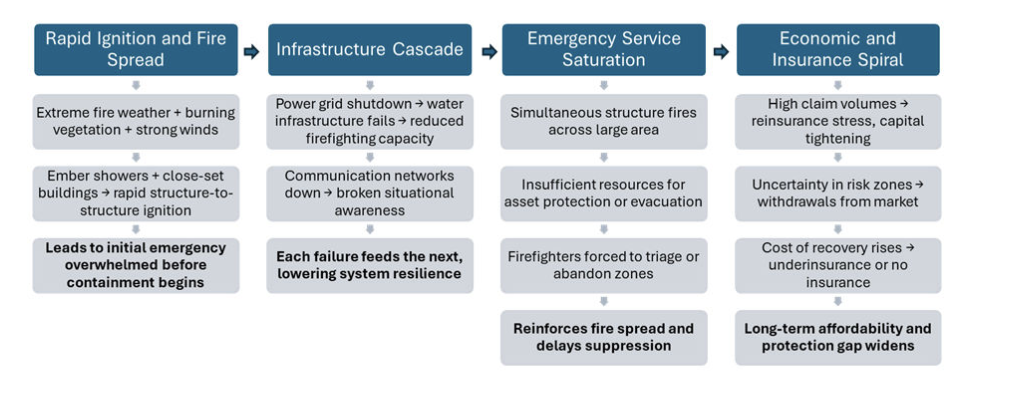
UC cascade is a systemic chain
All these factors, when combined, create an environment favorable to rapid fire spread. A system that behaves one way under normal stress behaves very differently when those stressors stack.
What makes UC so devastating is the typical sequence of events:
Implications for Los Angeles
Los Angeles is a City with close-set dwellings and aging building stock, and increasing policies that incentivize urban pattern density in the fire hazard zones.
Wildfire risk is already well-recognized in wildland or forested areas and wildland-urban interfaces; however, UC is about what happens after fire crosses into the built environment.
The hazard is then less about proximity to wildland and more about how structures and urban layout interact under stress.
This reveals a critical blind spot in risk assessment if UC scenarios are not properly considered in land management. As urban growth continues and fire seasons become more intense and prolonged, the threat of UC scenarios increases.
Understanding this hazard should inform land-use planning and policy. building standards, and risk modeling. However, current State policymakers and regulators continue to ignore UC.
The key question is not “Will UC happen?” but rather “Are policies making UC more likely in a warming, expanding city?”
To be clear: a full-scale UC as seen in the Palisades or Eaton Fires (2025) remains a rare, tail-end event. Yet its possibility grows as urban density, population growth, climate variability, and infrastructure interdependencies increase. Let’s look at why.
Policy must recognize that UC is not a scaled-up forest fire. It is a distinct phenomenon that can be modeled, with a series of required antecedents before the fires, and a series of events that must occur for a fire to then develop into a catastrophic scenario.
In catastrophe modeling terms, it represents a tail-risk event, where multiple variables produce order-of-magnitude loss escalation. The good news is that this type of phenomenon can be explicitly modeled to estimate its likelihood and intensity—offering a more accurate alternative then scaled-up forest fire fighting models that rely on vegetation removal.
The takeaway: Our yards are not a forest
Building-to-building fire spread led to widespread losses in Palisades and Altadena. The ingredients for another event do exist in Los Angeles. Acknowledging this is not alarmist—it is a necessary step toward improving safety.
Urban conflagration remains a blind spot in existing fire safety regulations, largely because it takes a backseat to housing density and relies on a conifer forest model.
California is on the verge of adopting regulations that will permanently reshape residential yards, urban tree canopy, and ecological systems. Speak with your elected representative about how California is addressing this blind spot in fire regulations and land use planning. And ask them why fire policy insider’s concerns about using a forest model for the urban environment have been ignored?